

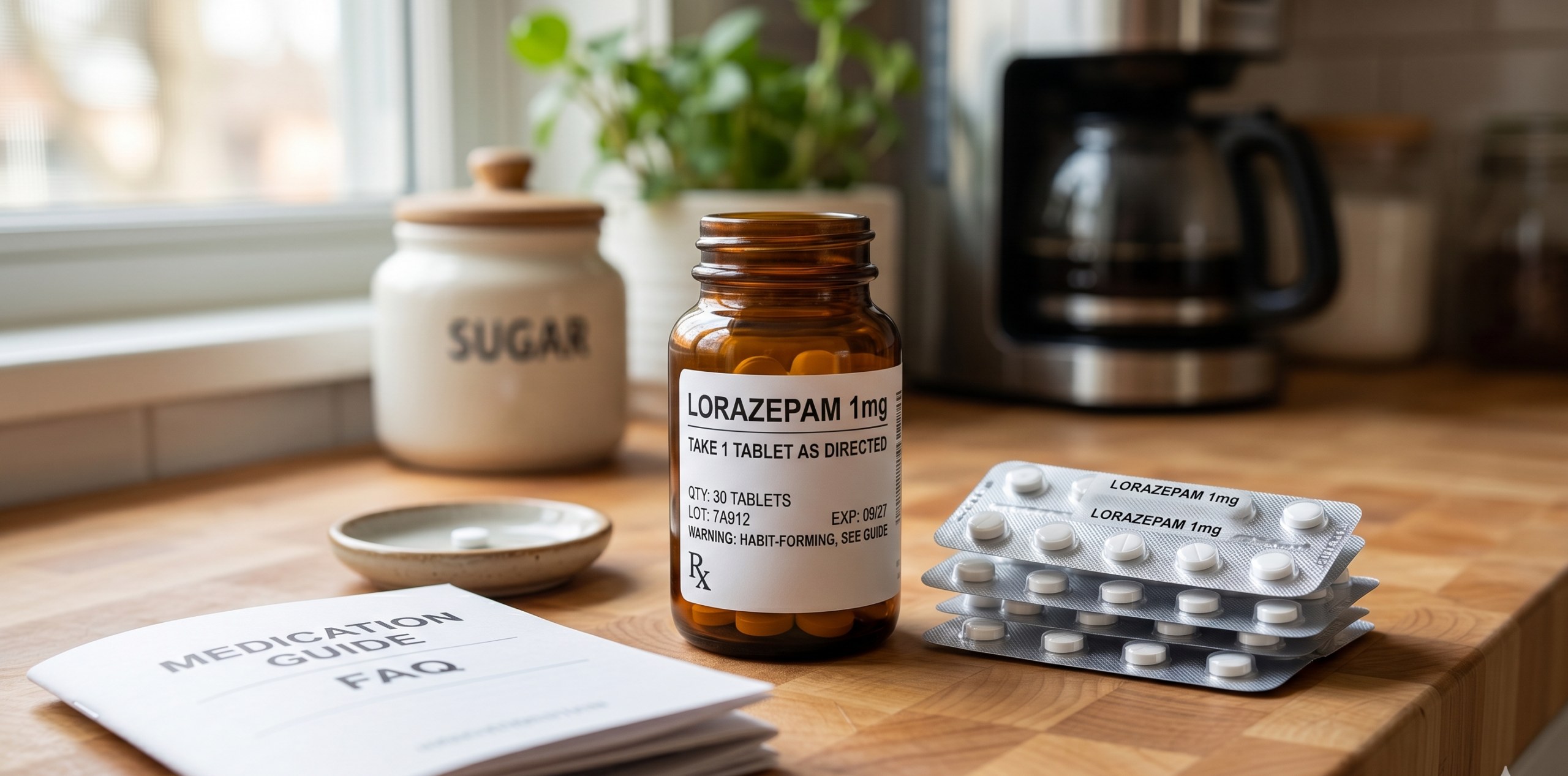
Frequently Asked Questions: Ativan (Lorazepam)
Medically reviewed by Dr. Sireesha Kolli — Board-Certified Psychiatrist, Kolli Psychiatric & Associates, Red Bank, NJ
Last reviewed: May 2026
This article is for educational purposes only and is not a substitute for medical advice. Do not start, stop, increase, or taper lorazepam without speaking with your prescribing clinician.
This page answers the most common questions patients ask about Ativan (lorazepam), drawn from real patient searches and from the questions that come up most often in our practice. For a complete clinical overview — what Ativan is, how it works, dosing, and side effects — see our main Ativan guide.
If you are weighing whether Ativan is right for your situation, our psychiatrists at Kolli Psychiatric & Associates see patients across Monmouth County, Ocean County, and statewide via telehealth.
Is Ativan the same as lorazepam?
Yes. Ativan is the brand name and lorazepam is the generic name — they are the same medication, with the same dose strengths and the same effects. The brand-name version (Ativan) and the generic (lorazepam) are interchangeable. Most prescriptions today are filled with the generic, which is significantly less expensive and equivalent in effect.
Is lorazepam a controlled substance?
Yes. Lorazepam is a Schedule IV controlled substance under federal law. This classification recognizes that it has accepted medical use but also has potential for misuse and dependence. Practically, this means prescriptions are limited in how often they can be refilled and require closer prescribing oversight than non-controlled medications.
Is lorazepam a narcotic?
No. In medical terminology, “narcotic” specifically refers to opioid pain medications such as oxycodone or morphine. Lorazepam is a benzodiazepine, which is a different drug class entirely and works by a different mechanism. It is sometimes informally called a “narcotic” because it is controlled and sedating, but this is not accurate use of the term.
Is lorazepam addictive?
Lorazepam can cause physical dependence, especially with regular daily use, higher doses, or longer duration of treatment. Dependence means the body has adapted to the medication and withdrawal symptoms may occur if it is stopped suddenly.
This is different from addiction, which involves compulsive use, cravings, and continued use despite harm. Both risks matter, which is why lorazepam should be used carefully and tapered under medical supervision when taken regularly.
How long does lorazepam stay in your system?
Lorazepam has a half-life of 12 to 18 hours, so most of a single dose is cleared from the bloodstream within roughly 2 to 4 days. Urine drug screens can typically detect lorazepam for several days after a single dose — often up to about a week — and longer with chronic daily use.
Hair testing can sometimes detect benzodiazepines over a period of weeks to months, though hair detection of benzodiazepines is variable and considered less reliable than urine. Individual factors like age, weight, kidney and liver function, and other medications can shift these windows.
How long does lorazepam take to work?
Oral lorazepam typically begins working within 20 to 30 minutes, with peak effect at 1 to 2 hours. Sublingual tablets work in roughly the same timeframe. IV lorazepam, used in hospitals, takes effect within 1 to 3 minutes. For PRN use — pre-flight, pre-procedure, panic episodes — taking the dose about 30 minutes before the trigger is generally the right approach.
How long does lorazepam last?
A single oral dose of lorazepam produces clinical effects for roughly 6 to 8 hours, though sedation and cognitive slowing can linger longer because of the 12 to 18 hour half-life. A 0.5 mg PRN dose tends to feel like it “wears off” sooner than a 1 mg dose, though the underlying half-life is the same. Most patients can expect a noticeable “soft landing” the next morning after an evening dose.

Find an Expert Psychiatrist
› Licensed to prescribe
› Trusted by patients and families with 100+ Google reviews
Is 0.5 mg of lorazepam a low dose?
Yes. 0.5 mg is the low end of standard adult dosing. For most adults, 0.5 mg PRN is a reasonable starting point — particularly for first-time benzodiazepine users or for patients sensitive to medications. 0.5 to 1 mg is the standard PRN range for adults. 2 mg in a single dose is considered high and is usually reserved for more severe acute anxiety, and doses above 2 mg are typically inpatient territory.
Is 1 mg of lorazepam a low dose?
1 mg is on the lower end of the standard adult PRN range — neither low nor high. For most adults with normal sensitivity to benzodiazepines, 1 mg produces noticeable anxiolytic and sedating effects within 20 to 30 minutes. It is a common starting dose for an as-needed prescription in adults under 65. For older adults, 0.25 to 0.5 mg is usually preferred.
What is the maximum daily dose of lorazepam?
The usual adult oral dosage range for anxiety is often 2 to 6 mg per day in divided doses, although prescribing should be individualized and some labeling allows a broader range.
In outpatient psychiatric care, many clinicians try to keep benzodiazepine dosing as low and as short-term as possible because higher daily doses increase the risk of sedation, cognitive slowing, tolerance, dependence, and withdrawal. Do not increase lorazepam without guidance from your prescriber.
Does lorazepam cause weight gain?
Lorazepam is not commonly associated with weight gain. Some patients report mild changes in appetite or weight in either direction, but lorazepam does not typically cause the metabolic weight gain associated with some psychiatric medications.
If you notice meaningful weight changes while taking it, it is worth discussing with your provider, since other factors — sleep, anxiety levels, other medications — may be contributing.
Does lorazepam lower blood pressure?
Lorazepam can produce a mild reduction in blood pressure, particularly in the first hour after dosing, because it reduces sympathetic nervous system activity (the body’s fight-or-flight response).
This effect is usually small and not clinically significant in healthy adults. In older adults, in patients on blood pressure medications, or with IV administration in a hospital setting, the drop can be more pronounced and is monitored more closely.

Work With an Executive Function Coach
› Practical strategies for ADHD
› Build systems that work with your brain, not against it
Can you drink alcohol on Ativan?
No. Combining Ativan with alcohol is one of the most consistent safety warnings on this medication. Both are CNS depressants, and the combination significantly increases the risk of profound sedation, respiratory depression, blackouts, falls, and overdose. Even moderate drinking can produce these effects when combined with lorazepam. If you struggle with alcohol use, this is something to address openly with your prescribing provider — there are safer treatment paths.
Can I take Ativan and weed together?
This combination is not advised. Cannabis and lorazepam both affect coordination, judgment, and mental clarity, and combining them tends to amplify these effects. Some patients also report increased anxiety or paradoxical reactions when mixing the two. If you use cannabis regularly, mention it to your prescribing provider — it affects how Ativan is dosed and monitored.
Lorazepam vs. Xanax — what’s the difference?
Both are benzodiazepines, but they differ in onset and duration. Xanax (alprazolam) works faster — within 15 to 20 minutes — but lasts a shorter time, roughly 4 to 6 hours of clinical effect. Lorazepam takes 20 to 30 minutes to start working but lasts longer, with a 12 to 18 hour half-life. Xanax is more often associated with rebound anxiety between doses; lorazepam tends to feel smoother but lingers longer the next day. The right choice depends on the clinical situation and the individual patient.
Lorazepam vs. clonazepam (Klonopin) — what’s the difference?
Both are benzodiazepines used for anxiety and panic, but Klonopin (clonazepam) is longer-acting. Klonopin’s half-life is roughly 30 to 40 hours versus lorazepam’s 12 to 18, which means Klonopin produces steadier blood levels with less between-dose fluctuation. Lorazepam is generally chosen for true PRN use because of its shorter duration; Klonopin is more often chosen when consistent daily coverage is needed. Per-dose onset is broadly similar between the two — typically 20 to 30 minutes for lorazepam and 30 to 60 minutes for clonazepam — though the difference is modest in practice. Withdrawal from Klonopin is typically slower-onset but can be longer; lorazepam withdrawal tends to start sooner but resolve sooner.
Lorazepam vs. Klonopin — which is better for anxiety?
Neither is universally better — the right choice depends on the type of anxiety. For situational, episodic anxiety where shorter duration matters, lorazepam is often preferred. For more constant, chronic anxiety where steady-state coverage is preferred, Klonopin is often preferred. The decision also accounts for individual factors: history of substance use, age, other medications, liver function, and personal response to each agent.
Lorazepam vs. diazepam (Valium) — what’s the difference?
Both work on the same GABA receptor system, but diazepam (Valium) is significantly longer-acting, with active metabolites that extend its half-life to 30 to 60 hours or more. Lorazepam has no active metabolites and a half-life of 12 to 18 hours. Diazepam is often chosen for alcohol withdrawal protocols and for benzodiazepine tapers, where a long half-life produces a smoother decline. Lorazepam is preferred when faster onset and shorter duration are clinically appropriate, or when a patient has liver impairment.
Can I take Ativan with my SSRI?
Can I take Ativan and trazodone together?
Ativan and trazodone are sometimes prescribed together, but only with clear guidance from a prescriber. Both can be sedating, so the combination may increase next-day grogginess, slowed reaction time, dizziness, falls, and impaired driving. This is especially important in older adults or in anyone taking other sedating medications.
Can you take lorazepam while pregnant?
Lorazepam is generally used cautiously during pregnancy and avoided when possible, especially for regular or long-term use.
Use late in pregnancy can produce sedation and withdrawal in the newborn. That said, untreated severe anxiety also carries risk during pregnancy. These decisions come up often in women’s mental health and are always individualized — made between the patient, the prescribing psychiatrist, and the OB. If mood symptoms continue or worsen after delivery, evaluation for postpartum depression is also important.
Do not stop lorazepam abruptly if you find out you are pregnant; call your provider.
How long does lorazepam withdrawal last?
Withdrawal symptoms typically begin within 1 to 3 days of the last dose, though the timing varies with dose, duration of use, and how the medication was stopped. Symptoms generally peak in the first week and ease over 2 to 4 weeks.
Acute symptoms — rebound anxiety, insomnia, tremor, hypersensitivity to light and sound — typically resolve in this window. A subset of patients experience protracted withdrawal symptoms (sometimes called PAWS) lasting weeks to months, particularly after high-dose, long-term use. A slow, supervised taper meaningfully reduces both severity and duration.
How do I taper off Ativan safely?
Tapering off Ativan should always be done under provider supervision. The general principle is gradual reductions — often 10 to 25 percent of the current dose every 1 to 2 weeks — slowed further if symptoms emerge.
For longer-term users, some providers bridge to a longer-acting benzodiazepine like diazepam (Valium) and taper from there.
Our team at Kolli Psychiatric & Associates builds individualized taper plans for patients across Monmouth County, Ocean County, and throughout New Jersey, in person and via telehealth. We do not rush tapers.
Can lorazepam be used for seizures?
Yes. IV lorazepam is one of the first-line treatments for status epilepticus — continuous or recurrent seizures lasting more than 5 minutes. In a hospital setting, it is given intravenously and works within 1 to 3 minutes. Oral lorazepam is not used for routine seizure prevention; that role belongs to dedicated antiepileptic medications.
Is lorazepam used for catatonia?
Yes. Lorazepam is the first-line pharmacological treatment for catatonia, a syndrome of motor and behavioral immobility that can occur in psychiatric and medical conditions.
The “lorazepam challenge” — administering lorazepam and observing the response — is both diagnostic and therapeutic. Patients with catatonia can show dramatic improvement within hours of dosing, which is part of why lorazepam holds its first-line status for this condition.
When should I take lorazepam before an MRI?
Most providers recommend taking lorazepam roughly 30 to 60 minutes before the scheduled MRI. The dose is typically 0.5 to 1 mg orally for adults — enough to ease claustrophobia without producing the deep sedation that would interfere with the technician’s ability to communicate with you. Plan for someone to drive you home; do not drive yourself after taking it.
What are the side effects of lorazepam in the elderly?
Older adults are particularly sensitive to lorazepam. Some observational studies have examined a possible association between long-term benzodiazepine use and dementia risk, but causality has not been clearly established.
The more immediate and well-established concerns in older adults are falls, fractures, delirium, memory impairment, sedation, and driving impairment. When lorazepam is used in this population, doses are typically lower — often 0.25 to 0.5 mg — and treatment is kept as short as possible.
Looking for anxiety treatment or a benzodiazepine taper in New Jersey?
Kolli Psychiatric & Associates provides psychiatric care across Monmouth County, Ocean County, Red Bank, and statewide via telehealth. Whether you are deciding whether to start a medication, looking to taper off one, or working through anxiety that hasn’t responded to your current treatment, we work collaboratively with patients on individualized plans.
Related reading on kollipsych.com
- For the full clinical overview, see the main guide: Ativan (Lorazepam): Uses, Dosage, Side Effects, and What to Expect
- If you are evaluating ongoing anxiety treatment options: Does Anxiety Medication Work?
- If you are also taking cold or allergy medication: Which Cold Medications Are Safe to Take with Antidepressants and Anxiety Medications?
- For ongoing therapy alongside medication: Talk Therapy Services in New Jersey