

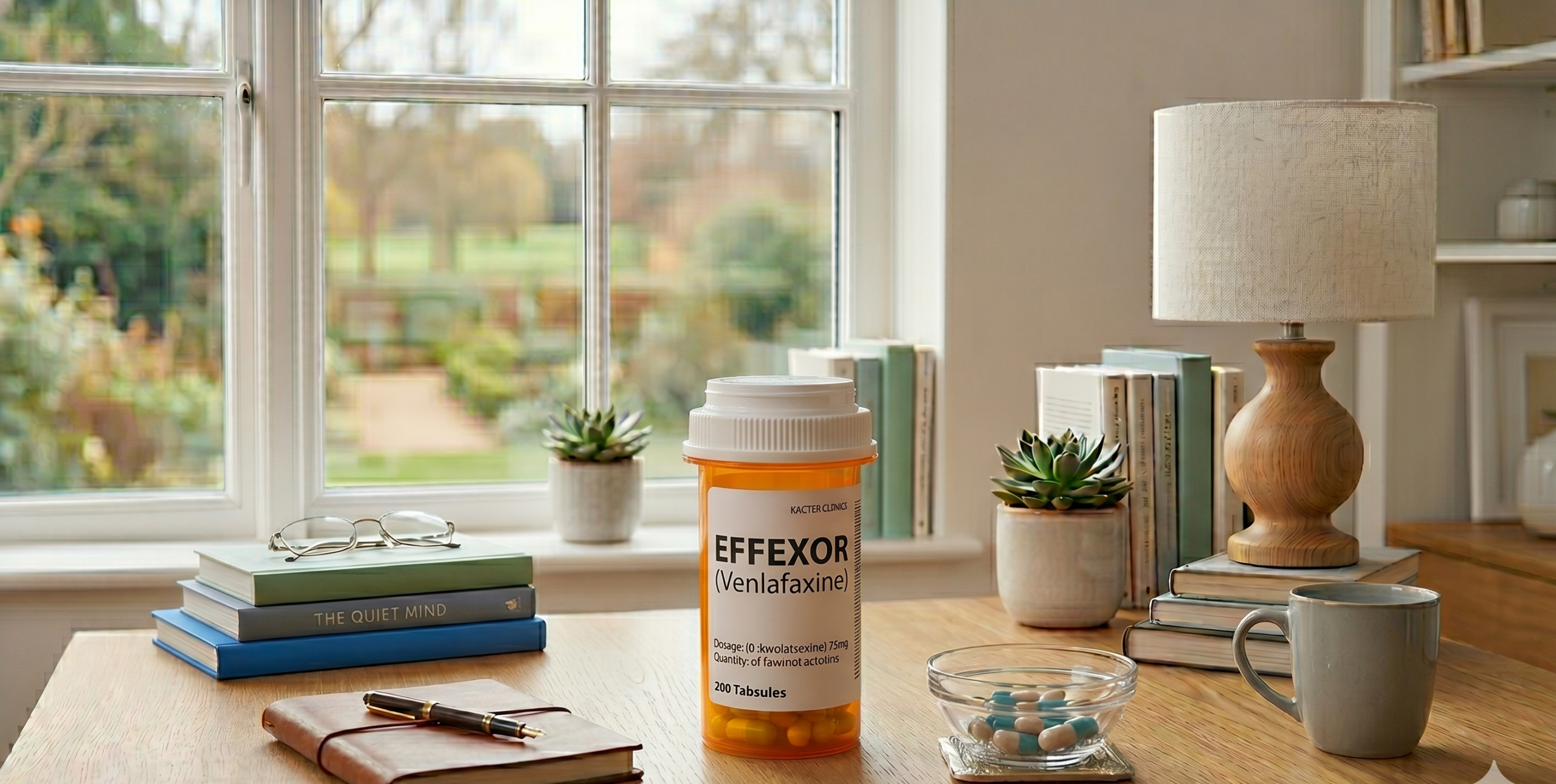
Effexor (Venlafaxine): Uses, Side Effects, Dosage & Withdrawal
Medically reviewed by Dr. Sireesha Kolli — Board-Certified Psychiatrist, Kolli Psychiatric & Associates, Red Bank, NJ
Last reviewed: May 2026
Effexor, also known as venlafaxine, is a prescription antidepressant used for depression, generalized anxiety disorder, panic disorder, and social anxiety disorder. This guide explains Effexor uses, side effects, dosing, how long it takes to work, withdrawal symptoms, and what patients should know before starting or stopping the medication.
Quick Answer
Effexor (venlafaxine) is a serotonin-norepinephrine reuptake inhibitor (SNRI) used to treat depression, generalized anxiety disorder, panic disorder, and social anxiety disorder.
It works by increasing serotonin and norepinephrine activity in the brain. The starting dose for Effexor XR is typically 37.5 mg daily. At any given dose, some patients notice early changes within 1–2 weeks and that dose’s full effect by 4–6 weeks, but reaching meaningful symptom improvement often takes several dose adjustments over time. Common side effects include nausea, sweating, and insomnia.
Effexor is not addictive but must be tapered under provider supervision.
What is Effexor?
Effexor is the brand name for venlafaxine, a serotonin-norepinephrine reuptake inhibitor, or SNRI. It was first approved by the FDA in 1993.
It is available as an immediate-release tablet, Effexor, and an extended-release capsule, Effexor XR. Effexor XR is the more commonly prescribed formulation today because steadier blood levels can mean fewer side effects and easier once-daily dosing.
Venlafaxine is FDA-approved for:
- Major depressive disorder
- Generalized anxiety disorder (GAD)
- Social anxiety disorder
- Panic disorder
Clinically, Effexor may be considered when a patient needs more than a serotonin-focused medication. Serotonin is one of the brain chemicals involved in mood and anxiety, and SSRIs mainly work by increasing serotonin activity.
For some patients, an SSRI does not provide enough relief. Effexor works on serotonin too, but at higher doses it also has more effect on norepinephrine, another brain chemical involved in energy, alertness, and the body’s stress response.
That is why Effexor may be considered when depression or anxiety includes symptoms such as low energy, fatigue, or certain pain syndromes, or when a patient has not had enough improvement with an SSRI alone.
At Kolli Psychiatric & Associates in Red Bank, NJ, Effexor is a regular part of the treatment toolkit for patients across Monmouth County, Ocean County, and statewide via telehealth psychiatry.
What does Effexor treat?
Effexor is used primarily for depression and anxiety, with several off-label uses in specific clinical situations.
For depression:
- Major depressive disorder (MDD) — the original FDA indication
- Persistent depressive disorder (off-label)
- Treatment-resistant depression, often as a second or third step after SSRIs
For anxiety:
- Generalized anxiety disorder (GAD)
- Social anxiety disorder
- Panic disorder
Off-label uses:
- Neuropathic pain (diabetic neuropathy, post-herpetic neuralgia)
- Migraine prevention
- Vasomotor symptoms of menopause (hot flashes)
- PTSD in select cases
How does Effexor work?
Effexor works by increasing the activity of two brain chemicals involved in mood and anxiety: serotonin and norepinephrine.
Brain cells communicate by sending chemical messages back and forth. After a message is sent, the brain normally reabsorbs some of those chemicals. Effexor slows that reabsorption process, which leaves more serotonin and norepinephrine available between nerve cells. Over time, this can help improve symptoms of depression and anxiety.
One thing that makes Effexor different from many antidepressants is that its effects can change depending on the dose. At lower doses, under roughly 150 mg, Effexor mostly affects serotonin. In that range, it can act more like an SSRI, which is a medication that mainly works on serotonin.
As the dose increases above 150 mg, Effexor’s norepinephrine effect becomes more meaningful. Norepinephrine is one reason Effexor may be considered when symptoms include low energy, fatigue, or when someone has not had enough benefit from an SSRI alone. At doses above 225 mg, some dopamine reuptake inhibition also appears, although serotonin and norepinephrine remain the main focus of the medication.
Because Effexor’s effects build in stages, it is usually started at a low dose and increased gradually. Starting low gives the body time to adjust before adding more norepinephrine effect at higher doses.
Increasing the dose too quickly does not usually make the medication work faster. Instead, it can increase side effects such as nausea, insomnia, and blood pressure elevation. A gradual titration helps balance benefit and tolerability.
How does Effexor make you feel?
Most patients do not feel Effexor working in a direct or immediate way. The changes usually show up gradually in mood, sleep, anxiety, and energy over several weeks, rather than as a sudden shift.
During the first 1–2 weeks, some people notice side effects before they notice improvement. Nausea, mild dizziness, sleep disruption, and occasional irritability can happen early on. These side effects often fade as the body adjusts.
Starting around weeks 3–4, patients may begin to notice that they feel less reactive to stress, ruminate less, or sleep more soundly. Full therapeutic effect typically develops over 4–6 weeks.
For patients whose primary concern is anxiety, the first two weeks can sometimes feel activating. This may feel like a jittery or keyed-up quality that resembles the anxiety they were hoping to treat. In many cases, this is temporary, but it may require a slower titration, a temporary adjunct medication, or a switch. This is one reason Effexor is often started at the lowest practical dose in anxious patients.
Emotional blunting is a potential side effect of Effexor. A subset of patients report feeling emotionally flat: less able to cry, less moved by things that used to matter, or more distant from relationships.
This is not the goal of treatment, and it should not be accepted as the price of being “better.” At Kolli Psychiatric & Associates, persistent emotional blunting is a reason to revisit the dose or the medication, not something patients should be told to simply live with.

Find an Expert Psychiatrist
› Licensed to prescribe
› Trusted by patients and families with 100+ Google reviews
How should I take Effexor?
Effexor is taken once daily (XR) or twice daily (IR), with or without food, at roughly the same time each day.
Standard dosing:
- Starting dose: 37.5–75 mg once daily (XR)
- Target dose: 75–225 mg daily
- Maximum dose: 375 mg daily for MDD; 225 mg daily for anxiety disorders
The maximum dose is rarely used in practice because side effects — particularly blood pressure elevation — tend to outweigh additional benefit at the top of the range.
Practical points:
- Effexor XR capsules should be swallowed whole. If swallowing is difficult, the capsule can be opened and the beads sprinkled onto a spoonful of applesauce, but the beads should not be chewed or crushed.
- Taking the dose with food reduces nausea, especially in the first two weeks.
- If a dose is missed and it is close to the next scheduled dose, skip the missed dose. Do not double up.
- Doses should not be skipped casually. Because of Effexor’s short half-life, even one missed day can trigger early discontinuation symptoms.
How long does Effexor take to work?
Effexor may begin producing noticeable changes in sleep, energy, and appetite within 1–2 weeks, with fuller therapeutic effect often developing over 4–6 weeks. Patients treated primarily for anxiety may sometimes feel benefit slightly earlier than patients being treated for depression.
If there has been no meaningful improvement by 6–8 weeks at a therapeutic dose, it is time to revisit the plan with your prescriber. Options may include a dose increase, an augmenting medication such as bupropion or an atypical antipsychotic, or switching to a different antidepressant class.
Early follow-up with a psychiatrist who can adjust the plan matters more than waiting indefinitely to see if things improve on their own.
How long does Effexor stay in your system?
Venlafaxine has a half-life of about 5 hours, and its active metabolite has a half-life of about 11 hours. This means Effexor is cleared from the body within roughly 2–3 days of the last dose. Steady state is reached within 3 days of consistent dosing.
The short half-life is clinically important. It is the reason discontinuation symptoms can appear within 24–48 hours of a missed dose, and the reason a slow, structured taper is essential when coming off the medication.
Is Effexor safe to take during pregnancy?
Effexor is classified as pregnancy category C, meaning animal studies have shown some risk, human data is limited, and the decision is made on an individual risk-benefit basis. It is not categorically unsafe, but it is not a medication that should be continued during pregnancy without a thoughtful discussion.
Known considerations include:
- Third-trimester exposure has been associated with neonatal adaptation syndrome, including jitteriness, feeding difficulty, and respiratory symptoms, which typically resolve within days of birth.
- Untreated maternal depression and anxiety carry their own documented risks to pregnancy outcomes and child development, including preterm birth, low birth weight, and postpartum complications.
- Venlafaxine passes into breast milk in measurable amounts. Most infants tolerate it, though monitoring is appropriate.
The right answer is rarely a blanket yes or no. For patients who are pregnant, planning pregnancy, or breastfeeding, the decision to continue, taper, or switch Effexor should be made collaboratively between a psychiatrist and the OB team, balancing symptom control against exposure risk.
Internet research can help patients prepare for that conversation, but this decision should be made through individualized medical care rather than general online guidance.
Who should be cautious with Effexor?
Effexor requires extra caution in patients with existing hypertension, a history of seizure disorder, older adults at risk for low sodium, patients taking NSAIDs or blood thinners, and patients taking other serotonergic medications.

Work With an Executive Function Coach
› Practical strategies for ADHD
› Build systems that work with your brain, not against it
What are the side effects of Effexor?
Most Effexor side effects are most pronounced in the first 1–2 weeks and fade as the body adjusts. Based on FDA prescribing data, common side effects include:
- Nausea (approximately 30%)
- Headache (about 25%)
- Dizziness (about 20%)
- Drowsiness (about 17%)
- Insomnia (about 15%)
- Sweating, including night sweats (about 14%)
- Dry mouth (about 12%)
- Sexual side effects — decreased libido, delayed orgasm, erectile difficulty
- Decreased appetite early on; weight gain can occur with longer uses.
Blood pressure elevation is specific to SNRIs and is dose-dependent. Clinically meaningful increases are most common at doses above 225 mg. Baseline blood pressure is checked before starting Effexor, and it should be monitored periodically thereafter, especially at higher doses or in patients with existing hypertension.
Serious but rare side effects include:
- Serotonin syndrome, particularly when Effexor is combined with other serotonergic medications
- Abnormal bleeding, especially with concurrent NSAIDs or blood thinners
- Narrow-angle glaucoma
- Hyponatremia, or low sodium, which is more common in older adults
- Seizures, which are rare, though the risk is elevated in patients with a history of seizure disorder
Like all antidepressants, Effexor carries an FDA black box warning regarding an increased risk of suicidal thinking in children, adolescents, and young adults up to age 24 during the first months of treatment. Close monitoring in this age group is essential. If you or someone you know is in crisis, call or text 988 to reach the Suicide and Crisis Lifeline.
A note on Effexor’s reputation
Patients researching Effexor will often find strong negative anecdotes online, especially about withdrawal or discontinuation symptoms. Those concerns should not be dismissed. Stopping Effexor abruptly can be genuinely difficult.
At the same time, the online reputation can make it hard to separate the experience of taking Effexor from the experience of stopping it too quickly. For many patients, Effexor is well tolerated when it is started thoughtfully, monitored appropriately, and tapered carefully when it is time to stop.
Can Effexor raise blood pressure?
Effexor can raise blood pressure in some patients, and this effect is dose-dependent. Blood pressure elevation is one of the side effects that is more specific to SNRIs like Effexor.
Clinically meaningful increases are most common at doses above 225 mg. For this reason, baseline blood pressure is checked before starting Effexor and monitored periodically afterward, especially at higher doses or in patients with existing hypertension.
When Should I call my Prescriber?
Call your prescriber if side effects are severe, persistent, or interfering with sleep, daily functioning, or your ability to stay on the medication.
You should also contact your prescriber promptly if you develop symptoms that could suggest a more serious reaction, including worsening agitation, suicidal thoughts, symptoms concerning for serotonin syndrome, unusual bleeding, significant dizziness, severe insomnia, or symptoms that feel different from your usual anxiety or depression.
If you are having suicidal thoughts or feel at risk of harming yourself, call or text 988 to reach the Suicide and Crisis Lifeline, or seek emergency care.
Stopping Effexor — what you should know about discontinuation
Effexor should never be stopped abruptly. Because of its short half-life, sudden discontinuation can produce symptoms that are significant, including brain zaps, dizziness, nausea, flu-like aches, irritability, crying spells, and vivid dreams.
These symptoms typically begin within 24–48 hours of the last dose and may last 1–4 weeks, depending on how the taper is handled.
Two distinctions matter:
- Discontinuation is not addiction. There are no cravings, no compulsive use, and no dose escalation. What is happening is a neurochemical adjustment as the medication leaves the system.
- Discontinuation is not relapse. Symptoms like dizziness and brain zaps are physiological, not psychiatric. They usually resolve as the brain readjusts.
A careful taper can prevent or reduce many discontinuation symptoms. Depending on the dose and duration of treatment, taper strategies may include gradual dose reductions over weeks to months, a bead-counting method within the XR capsule for fine control, or a bridge to fluoxetine, also known as Prozac, which has a much longer half-life and can make the final step off easier. The right strategy depends on the individual.
If you were started on Effexor by a primary care provider and are now looking to taper off, working with a psychiatrist who manages this regularly can make the process significantly easier. Psychiatrists at Kolli Psychiatric & Associates build individualized taper plans for patients across New Jersey, in person in Red Bank and via telehealth statewide.
For a complete breakdown of withdrawal timelines, brain zaps, bridge strategies, and combination questions, see the Effexor FAQ. If you are also considering over-the-counter cold or flu medications while on Effexor, see our guide to cold medications that are safe to take with antidepressants.
Looking for depression or anxiety treatment in New Jersey?
Kolli Psychiatric & Associates provides medication management and psychiatric care for patients across Monmouth County, Ocean County, Red Bank, and throughout New Jersey via telehealth. Whether you are starting Effexor, managing side effects, switching from another antidepressant, or looking for guidance on tapering off a medication started by another provider, our psychiatrists can help.
Key takeaways
- Effexor (venlafaxine) is an SNRI that raises serotonin and norepinephrine, giving it broader reach than SSRIs.
- It is FDA-approved for depression, GAD, social anxiety disorder, and panic disorder.
- Most patients see early changes in 1–2 weeks and full effect at 4–6 weeks.
- The medication’s online reputation is tied almost entirely to how it is stopped, not how it is taken — a slow, structured taper prevents most discontinuation symptoms.
- Blood pressure should be monitored, especially at doses above 225 mg.
- Effexor is not addictive. Dependence on a steady dose is not addiction — it is physiology.
This article is for educational purposes and does not replace medical advice from your prescribing provider.
External Resources